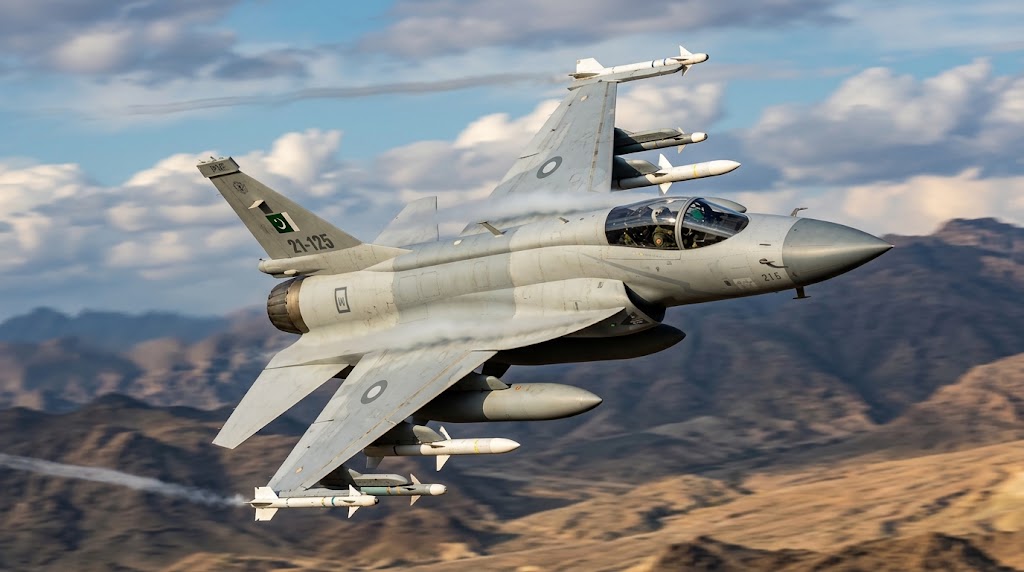
Pakistan’s JF-17 Thunder Fighter Plane
A cancelled American upgrade program. That’s where the JF-17 Thunder starts.
Not with Pakistan. Not with a clean-sheet design.
A Chinese design team kept working after its Western partner walked away. A Pakistani air force had just lost its main supplier.
Twenty years of upgrades later, you get a single-engine fighter now flown by four countries outside Pakistan.
It was never meant to beat an F-22 or a Rafale head-on. Affordable, hard to sanction, good enough — that was the whole point.
Azerbaijan has since signed a $4.6 billion order. Pakistan Aeronautical Complex has built more than 200 of these jets.
“Good enough” might not cut it as a description anymore.
What Is the JF-17 Thunder?
The JF-17 Thunder is a single-engine, lightweight fighter that can do more than one job. China calls it the FC-1 Xiaolong.
Pakistan Aeronautical Complex (PAC) and Chengdu Aircraft Corporation (CAC) built it together. Pakistan’s own name for it is “Joint Fighter-17.”
That “17” wasn’t picked at random. PAF planners saw this jet eventually replacing the F-16 in their lineup. China’s own name, Fighter China-1, just marks it as a separate program on their side.
It fills a pretty specific spot. Not a heavy air-superiority fighter, and it was never trying to be one.
Think light multirole jet, built for an air force on a budget. Something you can buy, fly, and keep running without the huge support network an F-16 or a Gripen needs.
Pakistan’s own air force says it does the same job as the F-16 for roughly half the cost.
Why Pakistan Needed the JF-17
Back in the late 1980s, Pakistan’s fighters were old. Mirage III and Mirage V jets, Nanchang A-5 bombers, Chengdu F-7 interceptors — most of it third-generation gear, all wearing out at once.
Then came the sanctions.
The 1990s hit Pakistan with US arms embargoes, first over its nuclear weapons program, later over the 1998 nuclear tests. Those sanctions kept blocking American jets Pakistan had already paid for.
If you only have one supplier, someone else’s politics can ground your air force overnight. Pakistan wanted a fighter it could build itself, with a partner that wouldn’t pull the plug.
China was that partner.
China had its own reasons to say yes — a working co-development setup already, and a shot at selling a cheap fighter to countries that could never buy Western.
What came out of it was a real 50-50 deal, both sides splitting the cost and the risk. That doesn’t happen often. Most “joint” fighter programs are one country calling the shots while the other just pays and waits.
Development of the JF-17
From the Super-7 Concept
Trace it back and you land on a design study called Sabre II — a Pakistan-Grumman-China plan to upgrade the Chengdu F-7, itself a Chinese-built copy of the MiG-21.
Grumman dropped out once the US sanctioned China after Tiananmen Square in 1989. China kept the idea going on its own, under the name Super-7.
By 1991 it had turned into the FC-1 program. A Chinese design team ended up owning the core airframe, not an American one.
Pakistan and China Join the Program
Pakistan and China signed an agreement in 1995. Russia’s Mikoyan bureau joined that same year to help with the design.
It took until June 1999 for both governments to sign the full contract. Around $500 million, split down the middle.
Plans to buy Western avionics from companies in Italy, France, and Britain dragged on for years. By 2001, the Pakistan Air Force just split the airframe work from the avionics work so at least one side could keep moving.
First Flight and Early Development
The first prototype rolled out on 31 May 2003. It flew that August.
Problems showed up right away. The RD-93 engine put out too much smoke.
Test flights turned up handling issues bad enough to force a redesign of the intakes and tail fin. The fourth prototype, flown in 2006, got a new diverterless supersonic inlet to fix it.
The whole thing took longer than either country wanted.
Introduction Into Service
Two early production jets landed in Pakistan in March 2007. They flew publicly at that year’s Pakistan Day parade.
Full squadron service kicked off on 18 February 2010, when No. 26 “Black Spiders” Squadron stood up with fourteen aircraft.
Final assembly moved to PAC’s Kamra facility from 2009 on. PAC now builds most of each jet at home.
JF-17 Thunder Variants
Block I
Block I was the starting point: built from 2007, running the original NRIET KLJ-7 radar, no aerial refuelling at all.
It carried the PAF through its first decade with the jet. It reportedly flew better than officials expected going in.
The fiftieth and last Block I jet came off the line in December 2013.
Block II
Block II started up the same month Block I stopped. No gap in between.
The big addition was an aerial refuelling probe, built to work with PAF’s Il-78 tankers. Block I never had that option.
Better avionics came along with it. So did a tactical data link, more electronic warfare gear, and more composite material to cut weight.
JF-17B
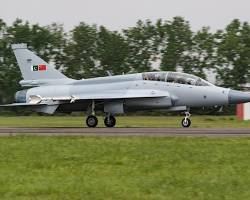
First flown in Chengdu in April 2017, the JF-17B is the two-seat trainer.
The fuel setup is different from the single-seaters. Fuel sits in the wings and, oddly enough, inside the tail fin itself.
That’s why the tail is taller and more swept back. Twenty-six were built for training, ground attack, and reconnaissance, with production running from 2018 to 2020.
Block III
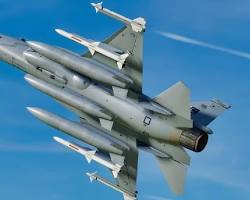
The current frontline version. It went into production at Kamra in December 2020 and reached PAF squadrons in March 2023.
It ditches the older KLJ-7 radar for the KLJ-7A, an AESA radar. It also adds a helmet-mounted display, an infrared search and track sensor, and a fully digital fly-by-wire flight control system.
It’s the first version cleared to fire the PL-15E, China’s long-range export missile. Pakistan Air Force officials call it “fourth generation plus.”
It’s also the version China and Pakistan are pushing hardest to export buyers.
JF-17 Thunder Specifications
| Specification | JF-17 (general / Block III sheet) |
|---|---|
| Role | Single-engine multirole fighter |
| Crew | 1 (single-seat); 2 (JF-17B) |
| Engine | Klimov RD-93 (Blocks I–II); RD-93MA, with WS-13 compatibility (Block III) |
| Length | 14.33 m |
| Wingspan | 9.44 m |
| Maximum takeoff weight | 13,500 kg |
| Maximum speed | Mach 1.6–1.8, depending on source and block |
| Service ceiling | Approximately 16,900 m |
| Payload | Up to 3,400 kg across eight hardpoints |
One thing worth saying up front instead of hiding in a footnote: most published JF-17 numbers come from one PAC marketing brochure, and that brochure is describing Block III specifically.
Earlier blocks weighed less. They flew a bit slower. They carried less, too.
So don’t trust a single number you find online unless the source actually says which block it’s talking about. A lot of aggregator sites just mash Block I, II, and III figures together without saying so.
Avionics and Technology
The radar tells you most of the story here. Block I and II ran the KLJ-7, a radar borrowed from China’s J-10.
Block III swapped that out for the KLJ-7A, an AESA radar. It can track around fifteen targets and shoot at several at once.
The cockpit changed too. Early jets had three color screens and a basic head-up display.
Block III got a bigger, thinner holographic HUD like the one on China’s J-10C. It also picked up a helmet-mounted sight, so the pilot can just look at a target to lock onto it.
Flight controls run digitally now — quadruple-redundant in pitch, double-redundant in roll and yaw.
Most of the electronic warfare gear lives in the tail fin. Radar warning receiver, missile warning system, jamming kit — all crammed into one spot.
Block III adds a better EW system on top of that. Recent Pakistani reports also mention a homegrown jamming pod called Panjnad, meant to cut down on foreign parts.
There’s a data link too, using the Link-17 standard, that lets the jet pass targeting info to other aircraft and to ground control. Handy — it means not every jet in the formation needs its own targeting pod.
The JF-17 as a Multirole Fighter
Multirole just means it does three different jobs.
Air defense: chasing down other aircraft, short-range heat-seeking missiles up close, radar-guided missiles at longer range. That got a lot better once Block III cleared the PL-15E.
Ground attack: bombs guided and unguided, anti-ship missiles, stand-off weapons like the Ra’ad cruise missile. No need for a separate bomber.
Reconnaissance and support, mostly handled by the JF-17B. Surveillance work and pilot training that would otherwise eat up front-line squadron time.
The math behind it is simple. One jet that can plausibly do three jobs costs less to buy and keep running than three separate jets would.
It just won’t do any one of those jobs as well as a plane built purely for that job.
Operators and International Interest
Pakistan still flies more of these than anyone else, by a wide margin. Over 160 jets across several squadrons.
Myanmar bought first, in 2015, ordering sixteen Block II jets. Things haven’t gone smoothly since.
Myanmar’s own media has reported cracked airframes and radar problems on part of the fleet. Sanctions after the 2021 coup made spare parts harder to get.
Nigeria came next, taking delivery of three jets in 2021. Those have flown counter-insurgency missions at home and, reportedly, strikes across the border into Benin.
Azerbaijan is the bigger deal lately. Baku signed a $1.6 billion Block III deal back in February 2024.
That grew to $4.6 billion for forty jets by June 2025 — Pakistan’s biggest defense export deal ever, and by most counts, the fourth country to actually fly the JF-17.
Deliveries started arriving in late 2025. Jets showed up publicly at Azerbaijan’s Victory Day parade that November.
Past those four, the list of interested countries is long and mostly just talk. Bangladesh, Iraq, Indonesia, Libya, and Somalia have all had talks or signed early agreements as of early 2026.
Saudi Arabia and Morocco have said they’re interested without committing to anything. The reported price tag stays well under most Western fighters.
Cheap doesn’t always mean sold, though. Sri Lanka and Argentina both walked away from serious talks and bought something else.
Malaysia dropped the JF-17 from a competition entirely.
JF-17 Block III and the Future of the Platform
Block III isn’t the last word here.
Pakistan’s already working on the next step, a program called “PFX,” sometimes called JF-17 Block 4 or PFX-Alpha. It’s supposed to go beyond Block III with a better radar, a homegrown infrared search and track sensor, and an electronic warfare system built specifically to jam AESA radars.
Officials said in early 2026 the jet could fly within four or five years. Nothing’s confirmed yet.
Either way, the direction is obvious: more Pakistani-made parts, less dependence on any one foreign supplier, and continued sales pitches aimed at countries the US, Russia, and Western Europe won’t sell to.
Why the JF-17 Matters
Forget the spec sheets for a second — the real story here is industrial, not tactical.
Pakistan got a domestic aerospace industry that basically didn’t exist before this program. Kamra now builds most of each jet instead of just bolting together imported parts.
China got a cheap export product that doesn’t compete with its own top-tier fighters.
Both countries got a jet whose supply chain doesn’t depend on one government’s sanctions list.
Is that a real export success, or just a handful of sales to countries that had no better options? Still up in the air.
The Azerbaijan deal argues for the first. A decade of near-misses with Sri Lanka, Malaysia, and Argentina argues for the second.
What is the JF-17 Thunder, in a sentence? A jointly built, Pakistan-assembled fighter, single-seat in most versions, two-seat in the JF-17B trainer.
Who builds it: Pakistan Aeronautical Complex and China’s Chengdu Aircraft Corporation, together. PAC does the bigger share of building and final assembly.
Is it multirole? Yes. Air defense, ground attack, and reconnaissance all fit inside what it’s built to do.
The difference between Block II and Block III comes down mostly to sensors and weapons: an AESA radar, a helmet-mounted display, infrared search and track, and clearance to fire the PL-15E. Block II had none of that.
The JF-17 joined the Pakistan Air Force in March 2007. The first full squadron stood up in February 2010.
Written by the techgenmag.com aviation and defense technology desk. Specifications and export figures vary by source and production block; figures above reflect Pakistan Aeronautical Complex’s published Block III data unless otherwise noted. Last updated September 2026.